“By the end of 2020, Newsweek reported that videos of people burning Harry Potter books were spreading like wildfire across TikTok. Historically, Harry Potter has been burned by right-wing fundamentalists who accuse J. K. Rowling of promoting witchcraft.” (p. 2)
“When Toni Morrison, the first African American woman to win the Nobel Prize in Literature, gave the Tanner Lectures at the Univserity of Michigan in 1988, she placed William Shakespeare, Henry James, and Herman Melville on the list of authors she could never live without.” (p. 47)
“Ray Bradbury’s 1953 masterpiece [Fahrenheit 451] was itself silently rewritten by his publisher, without his knowledge, because it, too, offended some readers. His publisher was ‘fearful of contaminating the young.’ For six years, the censored edition was the only paperback edition in print.” (p. 84)
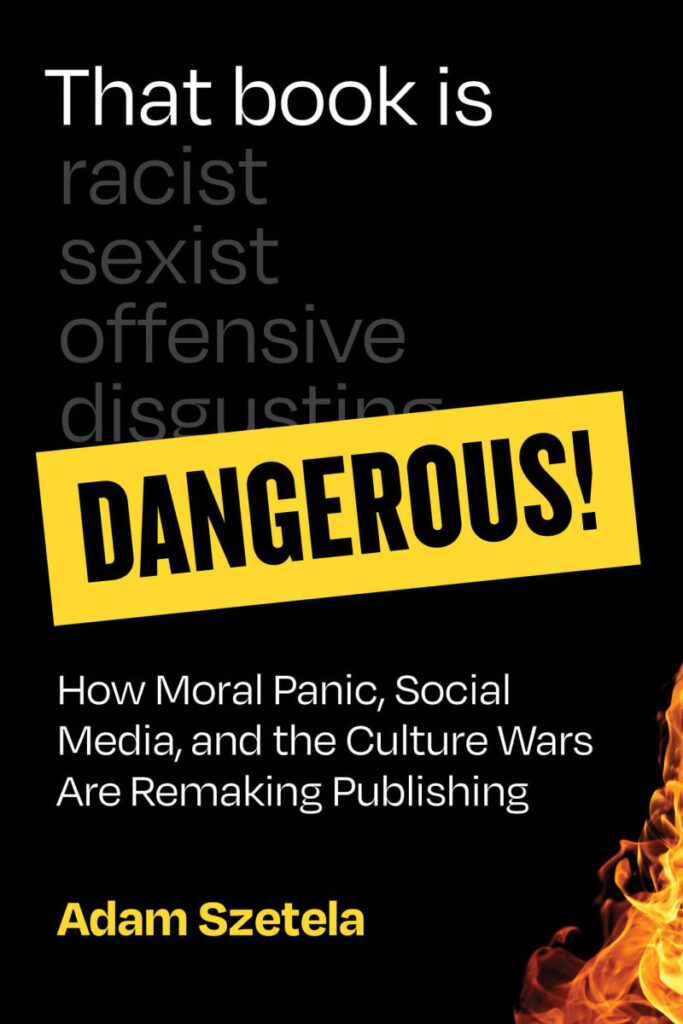
Adam Szetela’s That Book is Dangerous! explores the pressures exerted by groups on publishers to “modify” or simply not publish books that “offend” them. Szetela’s cites a dozen examples of books dropped by publishers because of social media hostility. And, we’re all too familiar with groups that attack books in school libraries that they claim are pornography or ideological.
I learned that most publishers today employ “sensitivity” readers to advise them on which books might generate negative reaction on TikTok or other social media platforms. Publishers are willing to go to great lengths to satisfy those “sensitive” readers–and to avoid confrontations. The result, of course, is censorship, thought-policing, and blatant editing of themes, characters, and situations that might be “provocative.”
Publishers are under intense pressure and scrutiny by groups threatening boycotts, public exhibitions like book burnings, and social media trashing. I knew publishers faced a lot a problems but That Book is Dangerous! shows in detail just how bad the situation is for authors, publishers…and readers today. Plus, if William Shakespeare, Mark Twain, Henry James, and Herman Melville are considered “Dangerous” by these wacky groups, we are in deep shit. GRADE: A
Adam Szetela earned his Ph.D. in English from the Department of Literatures at Cornell University. Before that, he was a visiting fellow in the Department of History at Harvard University. He writes for The Washington Post, The Guardian, Newsweek, and other publications.
Table of Contents:
Introduction: Welcome to the Sensitivity Era — 1
1 The Ideas of the Sensitivity Era — 9
2 The Behavior of the Sensitivity Era — 65
3 The Political Economy of the Sensitivity Era — 123
4 The Future of the Sensitivity Era — 169
ACKNOWLEGEMENTS — 197
NOTES — 206
INDEX — 259